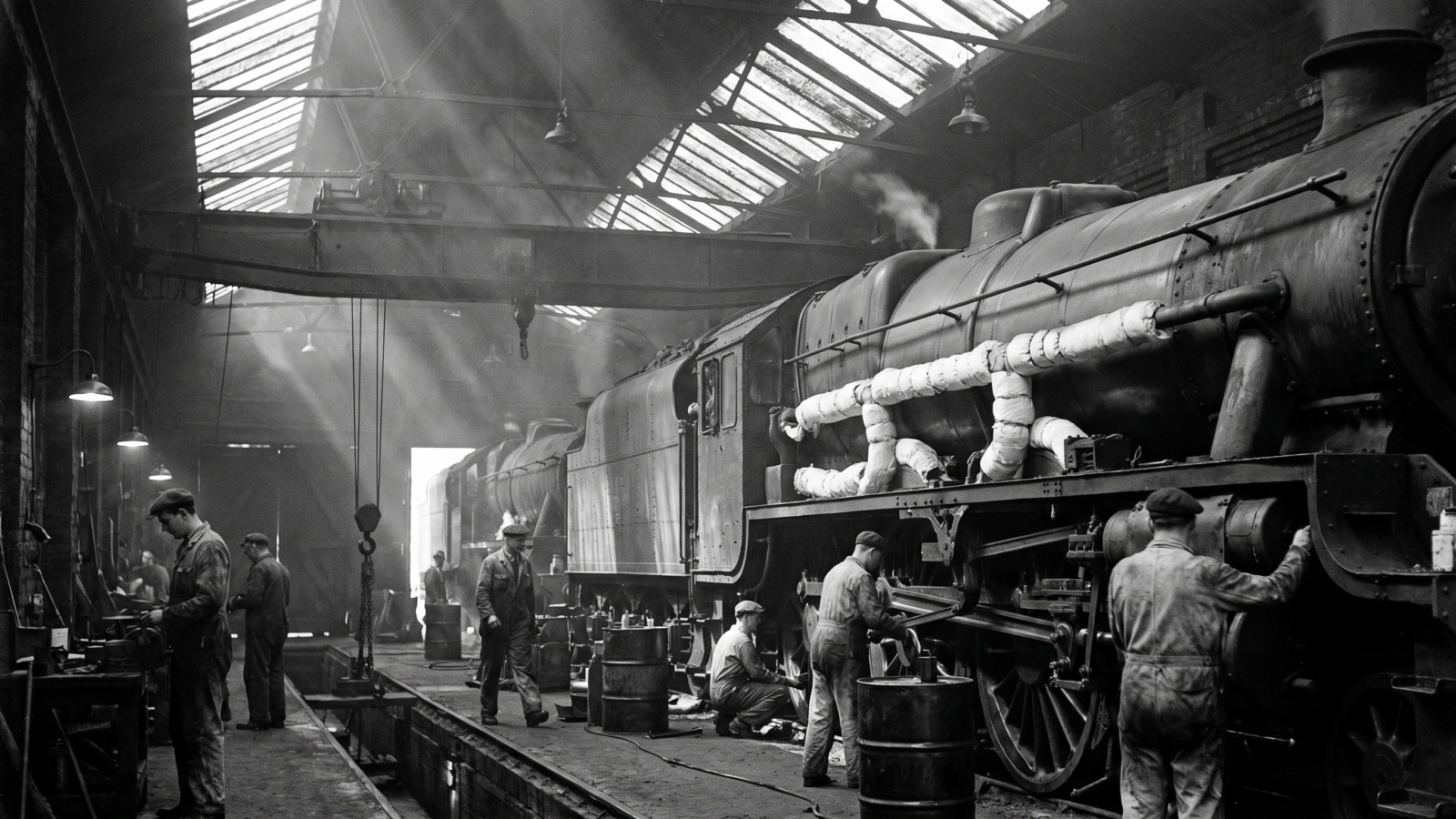
The men who kept American railroads running through the middle of the twentieth century — locomotive engineers, boiler room workers, carmen, machinists, roundhouse workers — worked in some of the most asbestos-intensive environments ever created. Steam locomotives were wrapped in asbestos insulation. Boiler lagging, pipe covering, gaskets, brake blocks, and fire doors all contained the mineral. Maintenance facilities where locomotives were rebuilt and repaired were chronically contaminated with asbestos dust.
Today, railroad workers and their families represent a significant portion of mesothelioma diagnoses — and they have a legal avenue that most other occupational groups do not: the Federal Employers Liability Act, which allows railroad workers to sue their employer directly for negligence in failing to provide a safe workplace. This is in addition to, and independent of, asbestos trust fund claims against the product manufacturers.
The Exposure History
Steam locomotives — the dominant form of rail traction through the 1950s — required extensive thermal insulation. Every surface that generated or conducted heat was wrapped in asbestos: the boiler itself, the steam pipes, the valves and fittings. Workers who maintained, repaired, or operated these locomotives inhaled asbestos fibres as a routine part of their work.
The transition to diesel locomotives in the 1950s and 1960s did not immediately eliminate the asbestos exposure. Early diesel locomotives also used asbestos in various components, and maintenance workers continued working with asbestos-containing gaskets, packing materials, and brake systems well into the diesel era. Roundhouse workers who maintained both steam and diesel equipment during the transition period faced a double exposure burden.
Railroad maintenance facilities — engine houses, roundhouses, repair shops — accumulated asbestos contamination over decades of steam locomotive maintenance. Workers in these facilities were exposed even if they never directly handled asbestos-containing materials themselves, simply through the environmental contamination of their workplace.
If This Investigation Affects You
If you worked for a railroad during the steam or early diesel era and have been diagnosed with mesothelioma or asbestosis, you may have both FELA claims against the railroad and asbestos trust fund claims against product manufacturers — simultaneously. These are separate legal processes and one does not reduce the other.
Trust fund claims are generally subject to statutes of limitations of 1 to 3 years from the date of diagnosis, varying by state. Acting now preserves your options.
Get a Free Confidential Case Review →
No obligation. No upfront cost. Initial communications are confidential. Attorney advertising.
FELA — The Distinct Legal Right
The Federal Employers Liability Act, enacted in 1908, allows railroad workers to sue their employer for negligence in failing to provide a reasonably safe workplace. Unlike workers’ compensation — which is typically the exclusive remedy for workplace injuries in other industries — FELA allows railroad workers to seek full damages through the court system, including pain and suffering, lost wages, and medical expenses.
For mesothelioma cases, FELA claims against the railroad employer are filed simultaneously with trust fund claims against the product manufacturers. The railroad’s liability under FELA is based on its own negligence — its failure to warn workers of asbestos hazards, its failure to provide respiratory protection, its failure to control exposure levels. The manufacturers’ liability in the trust fund system is based on the defective nature of their products.
FELA claims must typically be filed within three years of the date of diagnosis. They are subject to federal court jurisdiction and are tried before juries. Settlements in railroad FELA mesothelioma cases have historically been substantial, reflecting both the severity of the disease and the documented employer knowledge of the hazard.
The Trust Fund Connection
Railroad workers exposed to asbestos through product use have trust fund claims against the same manufacturers as other occupational groups. Johns-Manville supplied pipe and boiler insulation to railroads. Flexitallic — whose gasket products were widely used in railroad maintenance — is covered by the Flexitallic Asbestos Settlement Trust. Federal-Mogul’s packing and gasket products were used in railroad applications and are covered by the Federal-Mogul trust.
An experienced railroad asbestos attorney will typically pursue FELA claims against the railroad and trust fund claims against the product manufacturers simultaneously, with no reduction in either claim based on the other.
More from Worker Testimony